



If you are suffering from information overload, and looking for a way to organise your reams of data, a simple database can go a long way in reducing manual administration, whilst increasing productivity.
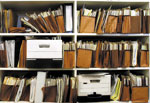
Perhaps the bigger questions are how can you put all this data to work and use the data you produce to become more organised, more productive and better able to share information of importance?
Your business probably has information scattered about everywhere: in spreadsheets, files, folders, documents and on paper. The secret to bringing this information together in a central location is the humble database. Now, don’t start snoring, I promise databases are not boring! They are the simple key to unlocking hidden productivity and reducing manual administration.
Running a business presents common challenges, especially when it comes to things like tracking your customers’ invoices and payments, maintaining up-to-date employee records and measuring business outcomes. There are however solutions for companies of all sizes to assist them with all of the above.
For some, databases may still seem intimidating and the exclusive domain of big business, but the truth is that easy-to-use, inexpensive database software does exist. And it is these systems that can free up the time business operators spend managing a business and allow them to get on with what they do best, grow the business!
Whether you’re managing a team or self-employed, database programs provide ready-to-use administration solutions for every type and size of business. A well-designed database program offers businesses management solutions that include:
- Managing contact and customer lists
- Tracking projects and tasks
- Coordinating group activities
- Creating quick and easy reports
- Tracking employee information
- Printing invoices, letters and mailing labels
- Connecting data, people and teams
- Storing digital assets and their descriptions
- Create inventories with photos
- Organising events and managing invite lists
A database is simply a big stack of cards with several bits of information on each card from text, numbers and dates to images, and web links. The database is what allows you to sort the ‘cards’ into lists (or ‘tables’ to use database terms) which in turn means you can store, sort and search lists of customers, projects you are working on, and items or images however you wish.
The main advantage to storing data in a database—as opposed to spreadsheets and documents—is that databases are designed to be easily searched. For example, you can’t ask Microsoft Excel to find which customer purchased product X. Databases allow businesses to centralise all information without having to jump from place to place and look for hundreds of files and folders. But they are not just about maintaining client records and contact lists. They provide the tools that small and medium businesses need to easily manage people, projects and assets, giving them the opportunity to compete with big business because their processes are equally streamlined, efficient and productive, if not more so.
While many companies utilise applications that have database-like functions—such as address books, calendars and photo management programs—and find them extremely useful, these programs cannot store all your different data in one central location nor can they use the different data from different locations to perform as many functions. But a genuine database can. For instance, you might have a list of customers, and a list of items you have sold, by ‘relating’ these lists you will see all the items a particular customer purchased. Try doing that with a spreadsheet! By linking all the records together you can improve the search functionality which in turn makes your data more meaningful and add value to managing your business.
Databases save time and money that SMEs spend on information management, so that owners and managers can focus on the higher value activities that result in happier customers and provide the greatest returns. A good database is a ready-to-use solution for SMEs which allows everyone to access and search information through an intuitive user interface and produce various reports at the click of only one button whenever required. Today’s databases can actually gather data from websites, create web databases, and give co-workers or customers access to your information wherever they are in the world, as long as they can access a browser.
So in short, databases do more than just hold data! They help you solve problems, answer questions, and make decisions. You can create formulas and calculations to help you analyse information, then whip together quick reports to help you share your insights. Making databases an invaluable tool for every business, big and small, and 2009 is a great year to take a closer look at the information in your business and think about how it could be put to work.
—Steve McManus is General Manager, FileMaker Inc. (www.filemaker.com.au) Asia Pacific.
What to look for in a database
Database technology can scare or confuse business owners and managers, however with the right advice it is easy to select a database, install it and begin to use quickly with high return on investment. Things you should look for or ask when choosing a database include:
- Is all the data stored in one location?
- Will it reduce manual data collection and ensure accuracy of data entry?
- Is the design interface attractive and accessible?
- Can you customise it to suit your needs?
- Can you search within it for information easily?
- Can you import information automatically with ease?
- Is it able to generate meaningful and correlated reports?
- What security features are there to limit access to information where necessary?
- Can you create formulas and calculations within it to analyse information?
- Will all your team have concurrent access to the information within the database?
- Does it have functions for automated printing of mailing labels, reports, invoices, badges for events and paper entry forms etc?
- Is it ready-to-use or will it require staff training?
Case study: Little Tots
Little Tots (www.littletots.com.au) produces an exclusive line of summer clothing, accessories and gift boxes for children aged 0-to-10 years. Managing Director Jody Phillips established the company after identifying a gap in the children’s clothing market. Phillips explained that as the demand for the clothing line grew, they needed systems and procedures to facilitate the expansion. “For the first three months we used Microsoft Excel to manage our business contacts but as the business grew we knew we needed a more sophisticated database administrative system and we chose FileMaker,” she said.
The addition of a database solution has had a positive impact on Little Tots and helped streamline administration procedures allowing Phillips to focus on promoting the business. “It has allowed us to organise company contacts, manage product images and stock, store event information and organise to-do lists. We can find the information easily and quickly by performing a keyword search. All of which allows me to spend more time marketing the business,” she said.
Phillips concludes: “Database technology improves the productivity and bottom line of small businesses. It frees owners from performing—or having to hire someone to perform—administrative tasks.”
People who read this, also liked:
Effective data quality strategies

